
COB LED Lighting: Efficiency, Power, and Precision for Every Application
- By Ledrise Led Professional
- Oct 20, 2025
Lighting design is rapidly evolving, and at the center of today’s innovation stands COB LED technology. Short for Chip-on-Board, COB LEDs deliver higher efficiency, superior light quality, and compact form factors compared to older LED packages. These attributes make COB LEDs the preferred choice for a wide range of professional lighting applications — from residential downlights to industrial high-bay fixtures.
In this article, we explore why COB LED lighting is transforming the industry, and we provide recommendations for the best configurable COB LED light-engine solutions for different applications.
Why Choose COB LED Lighting?
COB LEDs (Chip-on-Board) are arrays of LED chips mounted directly onto a substrate to form a single lighting module. This approach offers several key advantages:
- High Luminous Density: COB LEDs deliver powerful light from a compact source, making them ideal for spotlights and high-output fixtures.
- Improved Light Quality: Their large uniform emitting surface produces smooth, consistent light without the “multiple shadow” effect of older LED packages.
- Energy Efficiency: COB modules achieve higher lm/W efficiency, reducing energy costs while maintaining high brightness.
- Design Flexibility: With a wide range of sizes and outputs, COB LEDs are adaptable for residential, commercial, and industrial projects.
- Enhanced Thermal Management: Their design ensures better heat dissipation, extending LED lifetime.
Solutions by Application
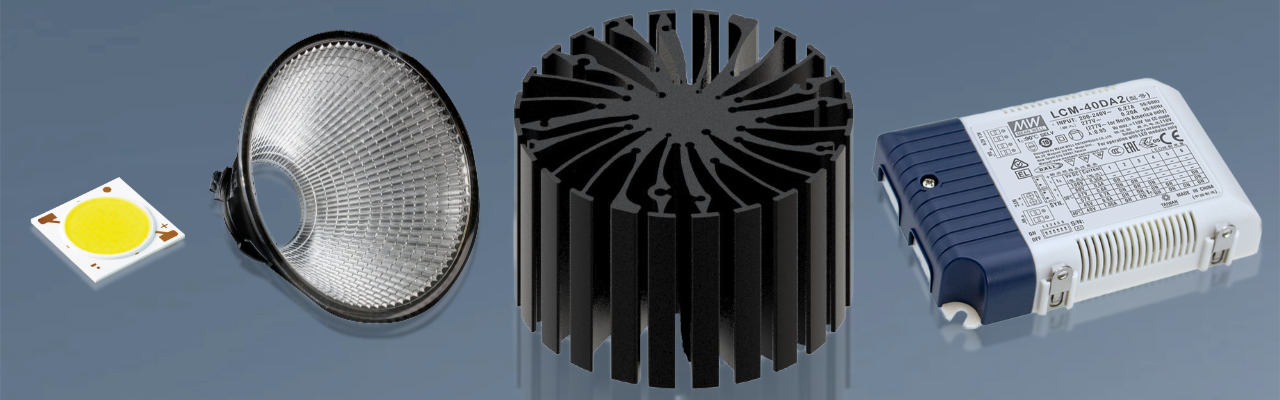
At Ledrise, we bring together the best technologies from industry leaders Nichia, LEDiL, MechaTronix, and MeanWell to create configurable COB LED light-engines. These modular solutions are tailored for specific applications and allow you to select the exact combination of COB, optics, heatsink, and driver that best fits your project.
1. Spotlights – Precision and Color Accuracy
Configurable COB Light-Engine for Spotlights

- Output: 500 – 2,000 lm
- CCT: 2200K – 6500K, Ra80 – Ra95
- Target Application: Retail, museums, galleries, and accent lighting where beam precision and high CRI ensure products and artworks appear at their best.
2. Residential Downlights – Comfort and Atmosphere
Configurable COB Light-Engine for Residential Downlights

- Output: 3,000 – 5,000 lm
- CCT: 2200K – 6500K, Ra80 – Ra95
- Target Application: Homes, apartments, and hospitality spaces needing comfortable, energy-efficient lighting with superior CRI for natural color rendering.
3. Commercial Downlights – Efficiency at Scale
Configurable COB Light-Engine for Commercial Downlights

- Output: 5,000 – 8,000 lm
- CCT: 2200K – 6500K, Ra80 – Ra95
- Target Application: Offices, retail spaces, and public buildings that require high lumen output, low maintenance, and energy savings across large installations.
4. High-Bay Lighting – Power for Industrial Spaces
Configurable COB Light-Engine for High-Bay Applications

- Output: 14,000 – 16,000 lm
- CCT: 2200K – 6500K, Ra80 – Ra95
- Target Application: Warehouses, factories, and sports halls where powerful illumination and long operational lifetimes are critical.
Trusted Components for Reliable Lighting
Each configurable light-engine integrates components from world leaders:
- Nichia COB LEDs – unparalleled efficiency and color consistency
- LEDiL optics – precise beam control and optical efficiency
- MechaTronix heatsinks – advanced passive cooling for LED longevity
- MeanWell drivers – reliable, efficient power management
COB LED lighting represents the future of professional illumination, combining efficiency, power, and design flexibility. Whether you are developing a spotlight for an art gallery, a cozy residential downlight, a commercial lighting system, or a high-bay for industrial spaces, Ledrise offers configurable COB LED light-engines that fit your exact needs.
Discover all solutions and start building your next lighting project with components from Nichia, LEDiL, MechaTronix, and MeanWell — the most trusted names in the industry.





