
Understanding the Color Rendering Index: A Comprehensive Guide to White Light Quality in Artificial Lighting
- By Ledrise Led Professional
- Nov 30, 2022

White light, as we perceive it, is a combination of different wavelengths in the electromagnetic spectrum. In artificial lighting, the quality and composition of white light can vary significantly depending on the technology used. To compare and quantify the white light quality of various artificial light sources, the International Commission on Illumination (CIE) introduced the Color Rendering Index (CRI) in 1974. In this in-depth guide, we will explore the basics of white light, the CRI, and its importance in choosing the right lighting fixtures for your home or business.
The Composition of White Light
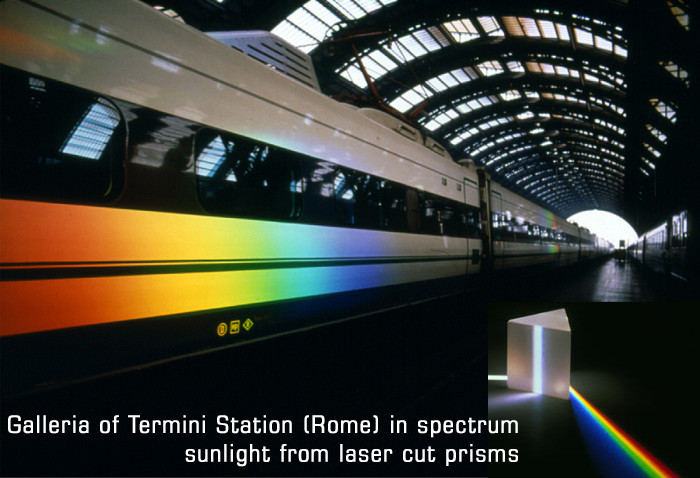
When sunlight passes through a glass prism, it separates into its various color components, demonstrating that white light is a combination of different wavelengths. To create white light from an artificial source, a mix of emitted wavelengths is required. However, not all artificial white light sources are the same, as they differ in their technology and composition.
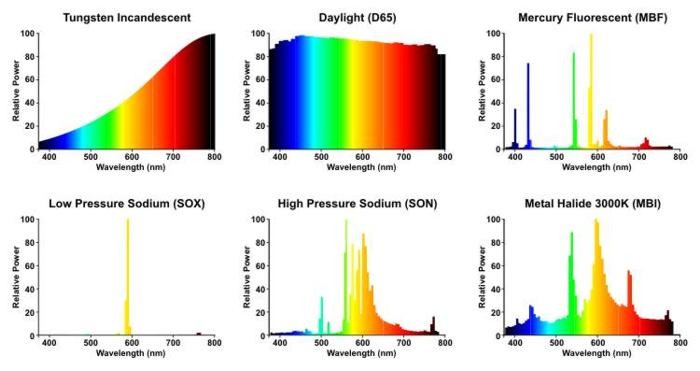
For instance, incandescent lamps emit light by heating a filament to high temperatures until it glows with visible light, while gas discharge lamps generate light by sending an electric discharge through an ionized gas. There is a wide variety of gas discharge lamps due to the many possible combinations of elements, such as the type of gas (neon, argon, xenon, krypton, neon) or metals (mercury, sodium).
The Color Rendering Index (CRI) Explained
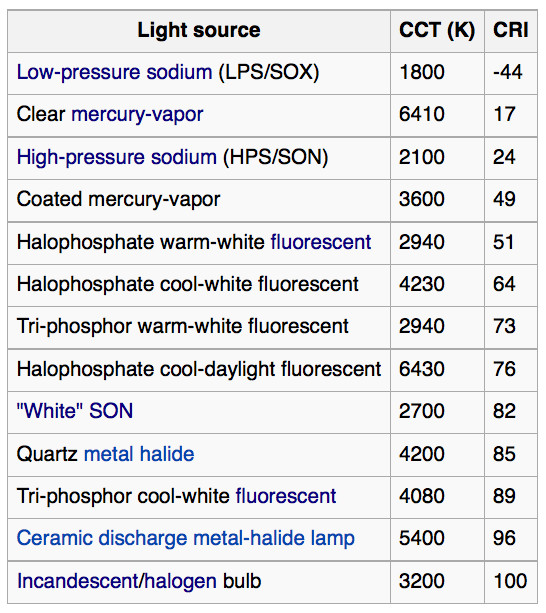
The CRI is a quantitative measure of how the spectrum of an artificial light source compares to a reference standard illuminant modeled after daylight. The highest possible score is 100, indicating a perfect match to the reference illuminant. Daylight and incandescent/halogen lamps typically score 100, while gas discharge lamps range between 17 and 96, with low-pressure sodium lights (yellow street lamps) even receiving negative values.
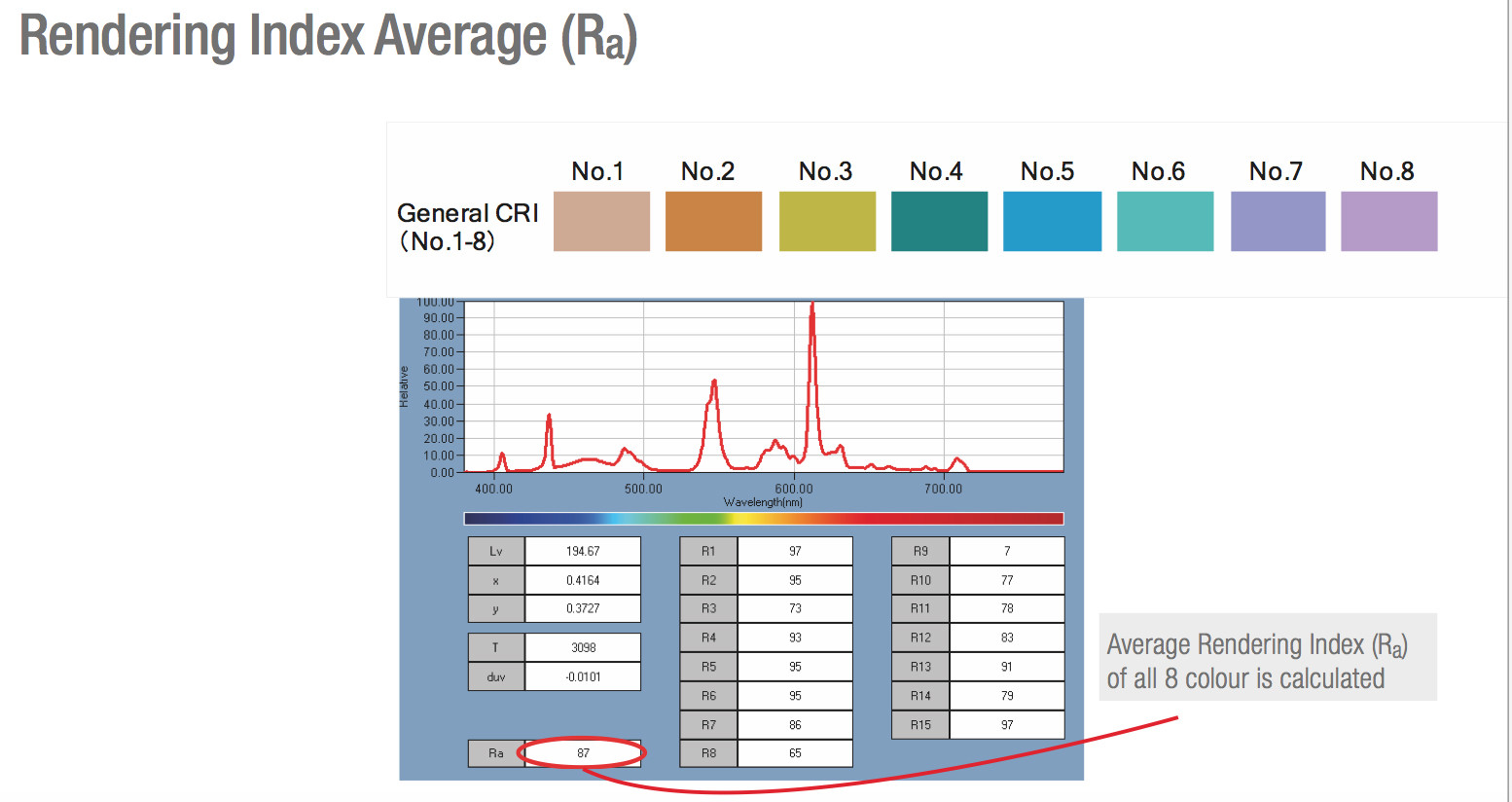
The CRI number is obtained through a standard calculation on the spectrum of the analyzed light source as it illuminates a set of eight reference colors. The illumination of these eight colors is compared to the standard illuminant or daylight, and the CRI index of the analyzed light source is the average of the eight individual scores.
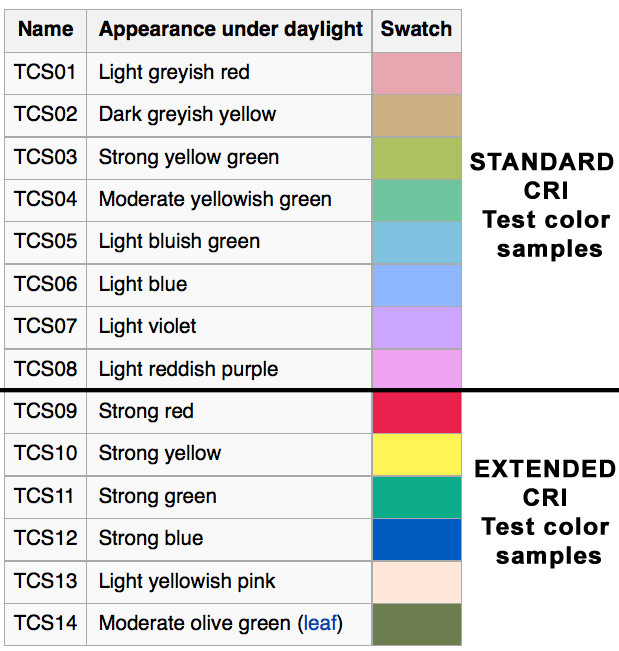
An example calculation from a dedicated CRI software below:
Here is an example of CRI index values for different lamps:
- Daylight: 100
- LED lights: 60-99
- Incandescent/Halogen Lamps: 100
- High-Pressure Sodium Lamps: 17-96
- Low-Pressure Sodium Lamps: Negative Values
LED Lights and the CRI
LED lights exhibit the widest variation in CRI values, with some having a CRI index of less than 60 and others scoring over 99. With such a large range of spectrum quality, it is crucial to consider the CRI index when purchasing lighting fixtures.
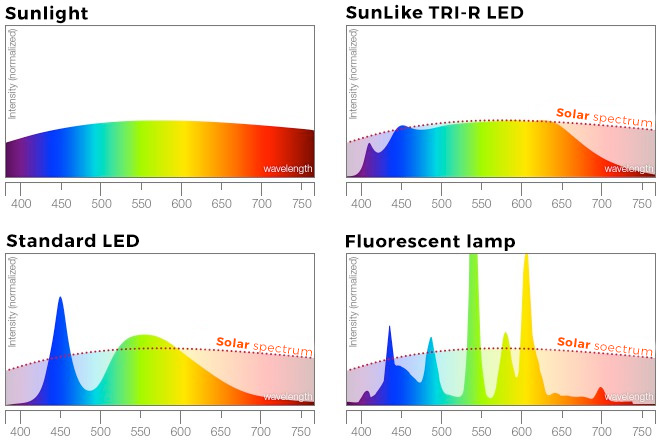
Currently, the highest CRI values for LEDs are achieved by new technologies such as Nichia Optisolis and Seoul Semiconductor SunLike, both offering almost daylight-like spectrums and maximum scores for all CRI test colors (99+). A comparison of their spectrums with sunlight and other light sources can be seen below:
The Importance of the CRI in Choosing Lighting Fixtures
When selecting lighting fixtures for your home or business, it's essential to consider the CRI index for several reasons:
- Color accuracy: A higher CRI value ensures that the colors of objects under the light source appear more accurate and vibrant, closely resembling their appearance under natural daylight.
- Visual comfort: High CRI lighting can contribute to increased visual comfort by reducing eye strain and promoting a more pleasant and inviting atmosphere.
- Task performance: In workspaces and other areas where color accuracy and visual clarity are essential, high CRI lighting can improve task performance and reduce errors due to inaccurate color perception.
-
Aesthetics: High CRI lighting can enhance the aesthetics of a space by accurately reproducing colors, making interior design elements and artwork look more appealing and true to their intended appearance.
-
Retail and display applications: In retail environments, high CRI lighting can positively impact sales by making products look more attractive and enticing to customers, while in museums and galleries, accurate color rendering is crucial for the proper appreciation of artwork.
Safety and navigation: In outdoor spaces or areas where visibility is essential for safety, high CRI lighting can provide better color differentiation, making it easier to identify objects and navigate the environment.
How to Choose the Right Lighting Fixtures with High CRI
When shopping for lighting fixtures, keep the following tips in mind to select the best high CRI options:
-
Look for the CRI value: Always check the product specifications for the CRI value before purchasing a lighting fixture. Aim for a CRI value of 80 or higher for most residential and commercial applications, and 90 or higher for spaces where color accuracy is crucial.
-
Consider the application: Determine the specific needs of the space you're lighting and choose a CRI value accordingly. For example, a high CRI might be more important in a kitchen or art studio than in a storage room.
-
Choose reputable manufacturers: Select lighting fixtures from reputable manufacturers with a proven track record of producing high-quality, high CRI products, such as Nichia Optisolis and Seoul Semiconductor SunLike.
-
Consult with a lighting professional: If you're unsure about the best lighting fixtures for your needs, consult with a lighting professional who can provide personalized recommendations based on your specific requirements and preferences.
The Color Rendering Index (CRI) is a crucial factor to consider when selecting lighting fixtures for your home or business, as it can significantly impact color accuracy, visual comfort, task performance, aesthetics, and safety. By understanding the CRI and its importance, you can make more informed decisions when choosing lighting fixtures, ultimately creating a better-lit and more visually appealing environment. Don't forget to always check the CRI value in the product specifications and opt for high-quality, high CRI products from reputable manufacturers to ensure the best possible lighting experience.
At Ledrise can find LED strips and modules with the highest CRI values possible today:
-
 CREE XPGEWT LED XPGEWT-01-0000-0P000ZJ6G Warm White 3-Step Ellipse 3500K CRI98 305lm€1.53Ships in 6-8 Weeks (with MOQ)
 -
CREE XPGEWT LED XPGEWT-01-0000-0P000ZJ6E Warm White 5-Step Ellipse 3500K CRI98 305lm€1.48Ships in 6-8 Weeks (with MOQ)
-
CREE XPGEWT LED XPGEWT-01-0000-0P000ZJ5G Neutral White 3-Step Ellipse 4000K CRI98 305lm€1.39Ships in 6-8 Weeks (with MOQ)
-
CREE XPGEWT LED XPGEWT-01-0000-0P000ZJ5E Neutral White 5-Step Ellipse 4000K CRI98 305lm€1.35Ships in 6-8 Weeks (with MOQ)
-
CREE XPGEWT LED XPGEWT-01-0000-0P000ZH7G Warm White 3-Step Ellipse 3000K CRI98 294lm€1.53Ships in 6-8 Weeks (with MOQ)
-
CREE XPGEWT LED XPGEWT-01-0000-0P000ZH7E Warm White 5-Step Ellipse 3000K CRI98 294lm€1.48Ships in 6-8 Weeks (with MOQ)
-
CREE XPGEWT LED XPGEWT-01-0000-0P000ZH6G Warm White 3-Step Ellipse 3500K CRI98 294lm€1.42Ships in 6-8 Weeks (with MOQ)
-
CREE XPGEWT LED XPGEWT-01-0000-0P000ZH6E Warm White 5-Step Ellipse 3500K CRI98 294lm€1.39Ships in 6-8 Weeks (with MOQ)
-
CREE XPGEWT LED XPGEWT-01-0000-0P000ZH5G Neutral White 3-Step Ellipse 4000K CRI98 294lm€1.30Ships in 6-8 Weeks (with MOQ)
-
CREE XPGEWT LED XPGEWT-01-0000-0P000ZH5E Neutral White 5-Step Ellipse 4000K CRI98 294lm€1.26Ships in 6-8 Weeks (with MOQ)
-
CREE XPGEWT LED XPGEWT-01-0000-0P000ZG7G Warm White 3-Step Ellipse 3000K CRI98 284lm€1.42Ships in 6-8 Weeks (with MOQ)
-
CREE XPGEWT LED XPGEWT-01-0000-0P000ZG7E Warm White 5-Step Ellipse 3000K CRI98 284lm€1.39Ships in 6-8 Weeks (with MOQ)
-
CREE XPGEWT LED XPGEWT-01-0000-0P000ZG6G Warm White 3-Step Ellipse 3500K CRI98 284lm€1.33Ships in 6-8 Weeks (with MOQ)
-
CREE XPGEWT LED XPGEWT-01-0000-0P000ZG6E Warm White 5-Step Ellipse 3500K CRI98 284lm€1.29Ships in 6-8 Weeks (with MOQ)
-
CREE XPGEWT LED XPGEWT-01-0000-0P000ZG5G Neutral White 3-Step Ellipse 4000K CRI98 284lm€1.22Ships in 6-8 Weeks (with MOQ)






